


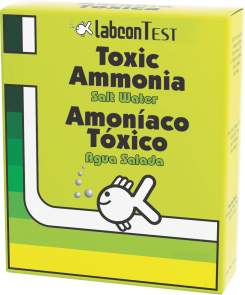
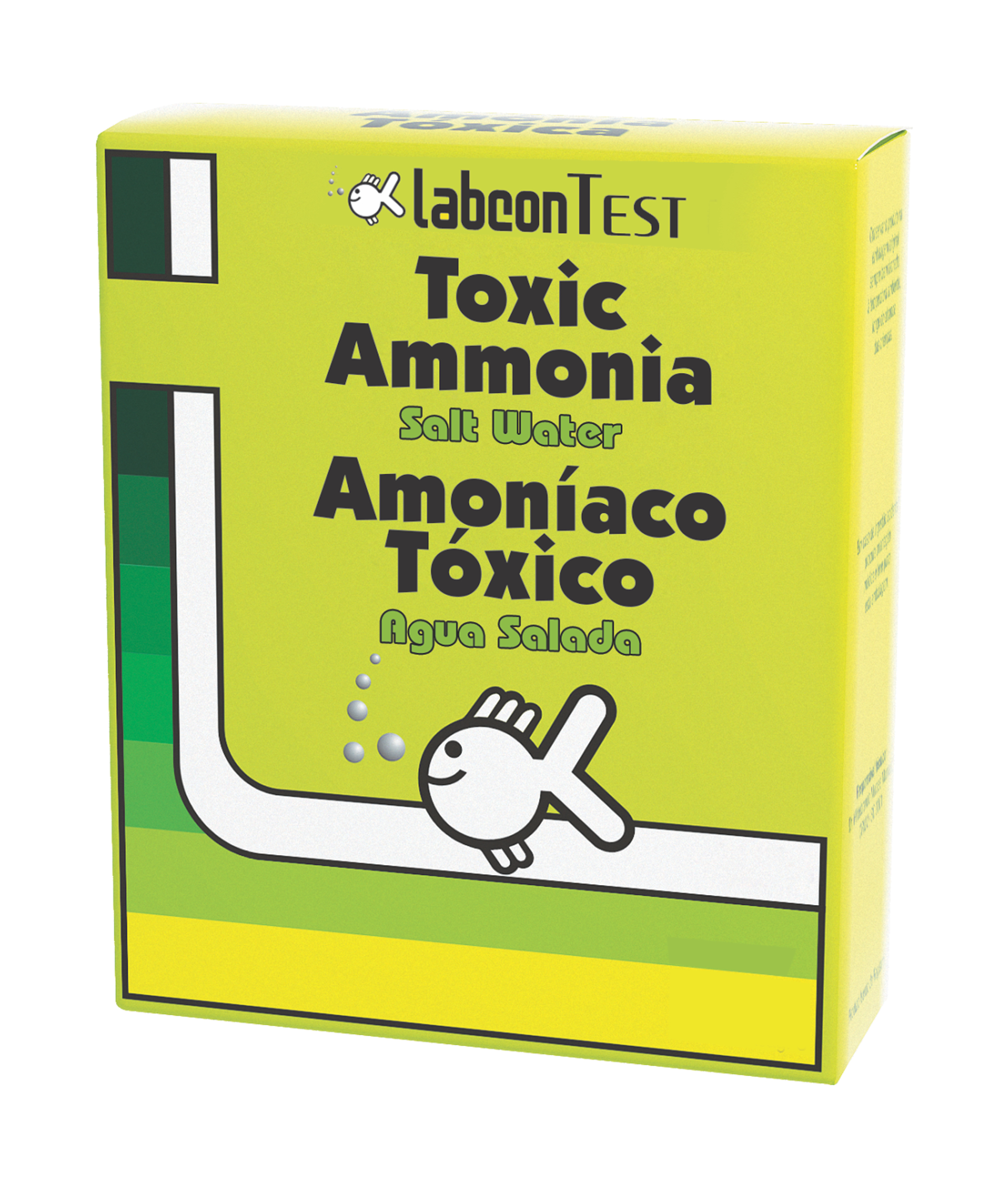
 labcon test toxic ammonia salt water




The influence of ammonia on fish: High levels of ammonia stress fish and consequently lowers its immune resistance, causing damage to gills, fins and intestinal surface, and disturbing oxygen absorption. Fish suffering from ammonia are looking panting, swimming on the surface and showing an apathetic behavior.
Toxic Ammonia: Ammonia can be present in the aquatic environment in two forms: ionized (NH4 +) and non-ionized (NH3). Only the NH3 form is important in terms of toxicity. As pH increases, the NH3 form increases its proportion. Therefore, the risk of intoxication increases significantly in aquariums with higher pH, such as marine aquariums.
Ammonia detection: Levels of NH3 below 0.02 ppm (green zone) can be considered as safe for fish, while levels above 0.04 ppm (red zone) indicate a risk requiring immediate action. Intermediate values (yellow zone) deserve attention.
What to do? When NH3 values above 0.04 ppm are detected (red zone), a siphoning of the bottom of the aquarium must be carried out with partial water changes. Check that the filtration system is working properly and reduce the feeding for a few days.
Feeding Guide
Instructions for use:
1) Fill the test tube up to the mark 1 with the aquarium water.
2) Keeping the reagent bottle in vertical position, add 8 drops of the reagent 1, cap the test tube and shake.
3) Keeping the reagent bottle in vertical position, add 8 drops of the reagent 2, cap the test tube and shake.
4) Keeping the reagent bottle in vertical position, add 8 drops of the reagent 3, cap the test tube and shake.
5) After 10 minutes, match the developed color in the test tube with the colors scale.
Put the open tube against the white circle and observe from above. Once defined the value of Total Ammonia, proceed to the reading table of NH3 (Toxic Ammonia).
Comments:
- For the accuracy of the result, it is essential to maintain the same size between the drops, therefore, the importance of carrying out the test keeping the reagent bottle in a vertical position.
- Carry out the test in a ventilated environment.
- Make the reading preferably under natural light.
- Wash the test tube after each test and keep it closed.
- Always keep the reagent bottles tightly closed, taking care not to switch the caps from one bottle to another.
Ingredients
Reagent 1: Sodium citrate, potassium hydroxide, distilled water.
Reagent 2: Phenol, sodium nitroprusside, isopropyl alcohol, distilled water.
Reagent 3: Sodium hydroxide, sodium hypochlorite, distilled water.
The use of products not purchased through our official distributor can be harmful to the health of animals because their origin, as well as their transport and conservation conditions, are unknown.